


Permalinks: What They Are & How to Structure Them for Max SEO Value
The truth is, permalinks and SEO have a lot more in common than you may realize, and — when done correctly — can play an important role in improving your website's ranking. Luckily, they are also simple to master.
Let's get into how permalinks work, how to create them, and set them on WordPress.
Let's break down this post's permalink.
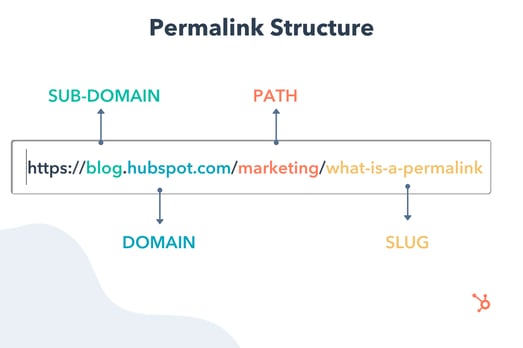
You first have your domain (and subdomain in some cases) which is where your website lives. It's followed by the path, which indicates the location of the page. In this example, the article is located under the "Marketing" category.
The last part of your URL is the slug — an essential part of your permalink and vital for SEO because it tells search engines how to index your site.
Each component creates a permanent link leading to a specific page on your website that is unlikely to change, hence the name "permanent."
When you don't customize your URLs using permalinks, you get a randomized ID. The problem is that this isn't attractive to site visitors and isn't optimized for search engines.
Let's say you're blogging about sponsored tweets and their value. Would you rather have the URL look like this:
yourdomain.com/sponsored-tweets-guide
Or like this:
yourdomain.com/post-id?=5726fjwenfkd
Probably the first one, right?
Great slugs should include the keywords targeted in the post. Take our example above: "sponsored-tweets-guide."
From this permalink, the reader (and Google) know the page is a guide to sponsored tweets and targets the keyword "sponsored tweets." This makes it easier for readers to find and share your content.
In addition, using keywords with high monthly search volume (MSV) in your slug can help you increase your ranking.
That's why when using a content management system (CMS) like CMS Hub or WordPress, you want to think about your permalink structure early on in your web development process.
What's the difference between a permalink and a URL?
A URL is a web address that directs to a page or file. It can include a domain name only, or also a path, slug, and other information depending on the page you are accessing.
On the other hand, a permalink refers to a specific URL structure — a tool made popular by bloggers for sharing and SEO purposes. While every permalink is a URL, not every URL is a permalink.
The Best Permalink Structures
With several permalink structures to choose from, think about your content and your audience to determine what format will work best.
For instance, a news site can greatly benefit from having a slug that includes a date and title. This lets readers know quickly by scanning what the post is about and when it was written.
On the flip side, if you manage a blog that prioritizes evergreen content and has pages that get constantly updated, you'll likely want to avoid having any dates in your titles.
That can signal to readers that your content is old and therefore, irrelevant. Instead, have a simple slug that only includes your article title.
It's all about using a structure that will benefit you (and your users) in the long run. Once you decide on a permalink structure, you can set it up in your CMS.
How to Make a Permalink
To make a permalink, all you need is:
- Your domain name
- Your slug
- Your path (if you have several topic categories and want to organize your content)
Then, there are a few best practices to keep in mind when deciding on your permalink structure:
- Keep it short – Avoid articles like "the," "a," "an" and create a slug that's a shorter version of your title. E.g.: If your article is titled, "How to Create an Instagram Story," your slug can simply be /Instagram-story.
- Include your main keywords – Optimize your slug by including your keywords. Make sure the keyword you use directly relates to the content on the page.
Now, in terms of where you go to create your permalink, that's typically on your CMS or Website Builder — such as WordPress, Wix, HubSpot CMS Hub, and Drupal. The ideal time to do this is shortly after developing your site but before any posts go live. However, you can also do this at any point.
If you decide to change old URLs to reflect your new structure, be sure to update all backlinks or set up redirects for those pages.
So, you're probably wondering how to optimize a permalink for WordPress. We'll cover that next.

No comments